
Sleep is often prescribed as medicine—but rarely do we ask how our patients sleep. In daily clinical practice, we focus on sleep duration, sleep quality, and disorders like insomnia or sleep apnea. Yet one factor remains consistently overlooked: sleep position. Modern research and applied physiology now make it clear that posture during sleep is not neutral. It directly influences cardiovascular function, digestion, brain health, and pregnancy outcomes.
Among the various sleep postures, side sleeping (lateral position) is physiologically superior to lying flat on the back or sleeping prone. However, even within side sleeping, the left and right sides are not equivalent.
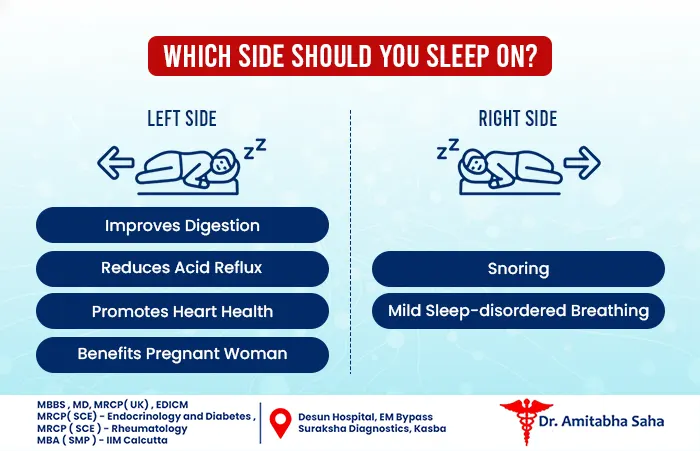
Anatomy explains much of this difference. The stomach is positioned primarily on the left side of the abdomen, while the esophagus enters from above. When a person sleeps on the left side, gravity naturally keeps gastric contents away from the esophagus. As a result, there is a significantly an reduced risk for nocturnal acid exposure. This position is particularly helpful for patients with heartburn, chronic cough, hoarseness and even reflux-related chest discomfort. There have been reports that left-side sleeping has led to noticeable relief from symptoms even before medications take full effect.
Moreover, it is seen that sleeping on the left also reduces the risk of cardiovascular disorders. Individuals who sleep in this position experience a smoother venous return due to decreased external pressure on the heart and lungs. If you are someone with cardiac enlargement, fluid overload or compromised cardiac reserve, doctors suggest sleeping on the left side for less breathlessness and more comfort.
Several neurological studies have explained another advantage of the left lateral position. It is found that when individuals sleep, the brain activates more waste-clearing pathways that help to remove the metabolic by-products. Side-sleeping facilitates this process more efficiently than the back position, playing a long-term positive role in brain health.
Pregnancy provides the strongest evidence of all. Left lateral sleeping is universally recommended because it improves uteroplacental blood flow and prevents compression of major veins. This is not optional advice—it is foundational obstetric physiology.
Digestive function also benefits. Left-side sleeping supports colonic movement and may ease constipation, bloating, and post-meal discomfort.
Right-side sleeping is often chosen for comfort, but physiologically it offers fewer protections. Acid reflux episodes are more frequent, and in pregnancy it is clearly inferior to the left. However, for some individuals with snoring or mild sleep-disordered breathing, right lateral sleep is still better than lying flat on the back.
The goal is not rigid perfection but directional awareness. It is all about guiding patients to use soft pillows, take mattress support, and build habits towards healthy sleep positioning without compromising on comfort.
According to Dr. Amitabha Saha, sleep is not a passive state. It is an active, restorative process influenced by posture. Good sleep is not only about hours; rather it is about orientation. Sometimes, turning to the left is not just comfort but also care.