Loneliness: When the Most Dangerous Disease Has No Symptoms
It does not appear on an X-ray.
It does not raise a fever.
It does not produce pain in the beginning.
Yet it quietly alters the brain, weakens the immune system, and shortens life expectancy.
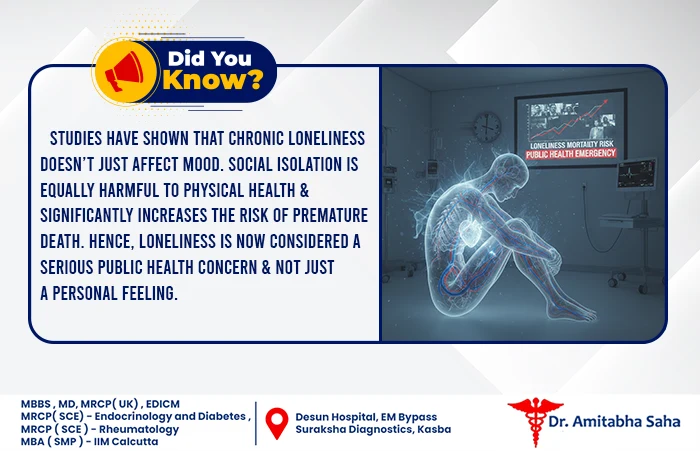
Loneliness is not just an emotion. It is a biological condition.
And in modern society, it is spreading silently.
The Crowded World Where People Feel Alone
Cities today are more crowded than ever. Apartments are stacked vertically. Roads are full. Workplaces are busy. Digital communication is constant.
Yet paradoxically, human connection is declining.
People migrate for education and employment, leaving behind families and familiar social networks. Nuclear families replace extended ones. Work schedules replace shared meals. Screens replace conversations.
From the outside, life appears connected.
From the inside, many individuals feel isolated.
This is the defining paradox of modern civilization—physical proximity without emotional connection.
The Brain Was Designed For Belonging
For millions of years, human survival depended on social groups. Being part of a community meant safety, protection, and shared resources.
Isolation meant vulnerability.
Because of this evolutionary history, the human brain developed systems that treat loneliness as a threat.
When individuals feel socially disconnected, the brain activates stress pathways.
Cortisol levels rise.
Inflammation increases.
The nervous system enters a state of alert.
The body behaves as if it is under danger—not from predators, but from absence of connection.
This response was protective in ancient environments.
But in modern society, loneliness often becomes chronic.
And chronic stress becomes chronic damage.
The Hidden Effect On The Heart And Immune System
Loneliness is not confined to emotional discomfort. It affects physical systems directly.
Persistent loneliness increases blood pressure. It accelerates vascular aging. It weakens immune defenses.
The immune system becomes less efficient at fighting infections.
Inflammatory processes become overactive.
This chronic inflammation contributes to heart disease, diabetes, and other long-term illnesses.
Individuals who feel socially isolated often experience slower recovery from illness.
Not because their treatment is inadequate, but because their biological resilience is compromised.
Human connection strengthens physiological resilience.
Its absence weakens it.
The Brain Itself Begins To Change
Loneliness affects the brain in profound ways.
The brain thrives on meaningful interaction. Conversation, emotional bonding, and shared experiences stimulate neural circuits that maintain cognitive strength.
Without these interactions, the brain receives less stimulation.
Neural networks weaken over time.
Memory begins to decline more rapidly.
The risk of dementia increases.
This is not simply due to aging. It is due to lack of cognitive and emotional engagement.
The brain, like muscle, requires use.
Isolation reduces that use.
And unused systems deteriorate.
Depression—The Emotional Consequence Of Isolation
Loneliness and depression are closely intertwined.
Humans derive emotional stability from shared experience. Being understood. Being heard. Being acknowledged.
Without these, emotional regulation becomes difficult.
Negative thoughts become more persistent.
Hope becomes harder to maintain.
Over time, loneliness can transform from a temporary feeling into a persistent emotional state.
Depression emerges not suddenly, but gradually.
It grows in the absence of connection.
The most dangerous aspect is that loneliness often remains invisible to others.
A person may appear functional, productive, and socially present.
Yet internally, they feel disconnected.
This internal isolation creates profound emotional strain.
Why Loneliness Is As Dangerous As Smoking
Smoking damages the body through toxins.
Loneliness damages the body through stress biology.
Both increase inflammation.
Both increase cardiovascular risk.
Both shorten lifespan.
The difference is visibility.
Smoking has visible behavior. Loneliness does not.
There is no laboratory test for loneliness. No scan that reveals it clearly.
Yet its biological consequences are real.
The heart does not distinguish between chemical damage and emotional stress.
Both produce physical harm.
The Modern Lifestyle That Fosters Isolation
Economic progress has improved living standards, but it has also altered social structures.
Mobility has increased.
Job demands have increased.
Time availability has decreased.
Relationships require time, presence, and emotional investment.
Modern life often deprioritizes these.
Efficiency replaces connection.
Productivity replaces presence.
Communication becomes transactional.
Over time, relationships weaken—not due to lack of care, but due to lack of time.
Loneliness emerges gradually, without intention.
The Workplace Impact—When Isolation Affects Productivity
Loneliness does not remain confined to personal life. It affects professional life.
Individuals who feel socially disconnected often experience reduced motivation, increased fatigue, and decreased cognitive performance.
Emotional resilience declines.
Stress tolerance weakens.
Decision-making becomes more difficult.
Workforce efficiency decreases—not due to lack of skill, but due to lack of emotional stability.
Organizations may not recognize loneliness as a factor in productivity, but its effects are measurable.
Human performance depends on emotional well-being.
Isolation weakens that foundation.
The Elderly—The Most Vulnerable Population
Loneliness affects all age groups, but its impact is especially severe in older adults.
Retirement reduces daily social interaction.
Loss of friends and spouses reduces emotional support.
Physical limitations restrict mobility.
Gradually, social networks shrink.
Isolation increases.
This accelerates cognitive decline, depression, and physical illness.
Loneliness becomes both cause and consequence of declining health.
It creates a self-reinforcing cycle.
The Irony Of Digital Connectivity
Technology allows instant communication across distances.
Yet digital interaction often lacks emotional depth.
Messages replace conversations.
Updates replace shared experiences.
Presence becomes virtual instead of physical.
The brain responds differently to real human interaction than to digital interaction.
Physical presence activates emotional bonding systems more strongly.
Without these signals, emotional needs remain partially unmet.
Digital connection cannot fully replace human connection.
The Biological Need To Be Seen And Understood
Humans are not designed to exist in isolation.
Connection regulates emotional stability.
It regulates stress responses.
It strengthens immune function.
It preserves cognitive health.
Being seen, heard, and understood is not a luxury.
It is a biological necessity.
Without it, the body enters a state of chronic stress.
And chronic stress accelerates aging and disease.
Loneliness Is Not Weakness—It Is A Signal
Loneliness is often misunderstood as a personal failure.
In reality, it is a signal.
A signal that a fundamental biological need is unmet.
Just as hunger signals the need for food, loneliness signals the need for connection.
Ignoring it does not eliminate it.
It intensifies it.
Recognizing loneliness allows intervention.
Connection can be rebuilt.
Relationships can be restored.
But awareness must come first.
Society Must Recognize Loneliness As A Health Risk
Healthcare has traditionally focused on physical diseases.
But emotional and social conditions produce physical consequences.
Loneliness increases healthcare burden.
It increases hospitalization rates.
It increases long-term disease risk.
Addressing loneliness is not only a psychological priority.
It is a medical priority.
Preventing isolation improves health outcomes.
It improves quality of life.
It reduces long-term healthcare costs.
The Silent Epidemic Of Modern Society
Loneliness does not spread through infection.
It spreads through disconnection.
Through migration.
Through social fragmentation.
Through absence of time for relationships.
It is silent.
Invisible.
Yet deeply impactful.
Many individuals carry loneliness quietly, without expression.
But their bodies carry its consequences.
Take-Home Message
Loneliness is not simply an emotional experience.
It is a biological condition that affects the brain, heart, immune system, and lifespan.
Human connection is not optional for health.
It is essential.
In the modern world, protecting physical health requires protecting emotional connection.
Because sometimes, the most dangerous threats are not the ones we can see—
But the ones we silently feel.
- Dramitabhasaha
- 17th Feb, 2026
- General Medicine Doctor
- Tags: Loneliness