Antimicrobial resistance (AMR) has become a global threat, with predictions that about 10 million people will die every year from drug-resistant infections by 2050.
Given the growing problem of AMR, currently, the number of deaths caused is around 5 million globally per year, and it is going to rise even more as infections become harder to treat.
This worldwide crisis would not only put the lives of individuals at risk but also affect the foundation of modern medicine, whether it is surgery, cancer treatment, or any other therapies that heavily rely on antibiotics to prevent infections.
Antimicrobial resistance occurs when microorganisms such as bacteria, viruses, fungi, and parasites no longer respond to antimicrobial agents to which they were initially sensitive.
Microbes have now developed the ability to survive exposure to these drugs that they were once susceptible to.
As a result, the microbial medications have lost their effectiveness, making infections harder or almost impossible to treat with severe consequences. This has increased the likelihood of disease transmission, disability, severe illness, and even death.
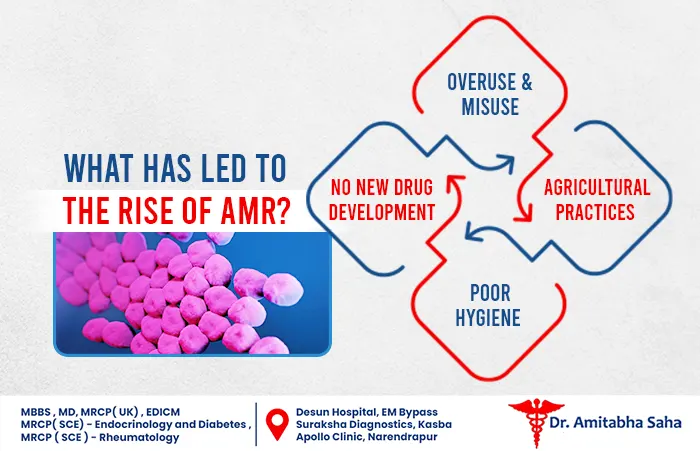
There are several factors that have resulted in the emergence and spread of AMR.
Doctors often prescribe antibiotics for viral infections or other conditions caused by a virus, where they are not effective. Sometimes, patients engage in self-medication and take the drugs based on previous prescriptions. Moreover, incomplete completion of the treatment is also another reason behind allowing the microbes to survive and even multiply.
The widespread use of antimicrobial agents, both for disease prevention and promoting growth, has accelerated the development of resistant strains that are often transmitted to humans.
Lack of access to clean water and hygienic sanitation practices has increased the risk of infection. Poorly controlled infections in healthcare settings and other communities have facilitated the spread of antimicrobial-resistant microorganisms.
Lack of development of new antimicrobial drugs has made it more challenging for individuals to fight against resistant microbes.
According to the World Health Organisation (WHO), AMR is increasing at an alarming rate beyond our ability to control. Due to insufficient research, the crisis is posing a serious threat to global health.
There is an urgent need to call to combat AMR effectively, which demands a multifaceted approach.
Scientists are now searching for antibiotics in several environments—from the deserts and oceans to even the human microbiome. Microbiologist Cristina Dorador’s soil sampling in the Atacama Desert has become one such hunting ground to search for antibiotics. Moreover, in March 2025, Nature published findings about discovering a new molecule with the potential to kill drug-resistant bacteria in Ontario.
In addition to traditional antibiotics, promising strategies include bacteriophage therapy, CRISPR‑Cas antimicrobials, anti‑virulence agents, vaccines, and microbiome‑derived compounds. For example, CRISPR‑based approaches can be employed to precisely target resistance genes in pathogens like S. aureus and E. coli.
Antimicrobial resistance (AMR) is a preventable crisis that needs to be addressed through proper research and public awareness. If we fail to do so, soon we will go back to the pre-antibiotics era, where minor infections will prove to be life-threatening.