Are Home Blood Sugar Monitoring Devices Accurate?
For millions of people dealing with diabetes, home glucose monitoring metres are more than just gadgets; they are an essential. You just need to prick your fingers, and the home glucose meter monitor displays a number that measures the levels of your blood sugar.
Most people rely on these small handheld devices to decide the quality of food they are going to eat, as well as the medications. But the question is, are these devices really that accurate? Or, how do they prove to be effective when it comes to blood sugar treatment amidst the rising prevalence of diabetes?
Let’s get the answer from Dr. Amitabha Saha, a leading general physician providing high blood sugar treatment in Kolkata.
How Do Glucose Monitoring Devices Work?
Sugar testing machines, or glucometers, are devices that measure fluctuations in the blood sugar levels, whether a spike or a dip. They obtain readings by pricking the skin and placing a small drop of blood on the test strip connected to the device.
One of the advantages of these devices is that they give instant readings which were not possible earlier. In traditional lab testing, patients had to wait for a few days before getting real-time feedback.
Most of these modern devices are compact, portable, user-friendly, and often come with memory storage or Bluetooth connectivity to sync with mobile apps.
Accuracy Of The Home Blood Sugar Monitoring Devices
Home glucose monitoring devices are accurate but not as precise as laboratory tests. According to Dr. Amitabha Saha, well-known for high blood sugar treatment in Kolkata, these devices can be convenient but not perfect.
Globally, glucometers are regulated by standards such as the ISO 15197:2013, which requires that
95% of readings must fall within ±15% of laboratory values.
99% must fall within ±20%.
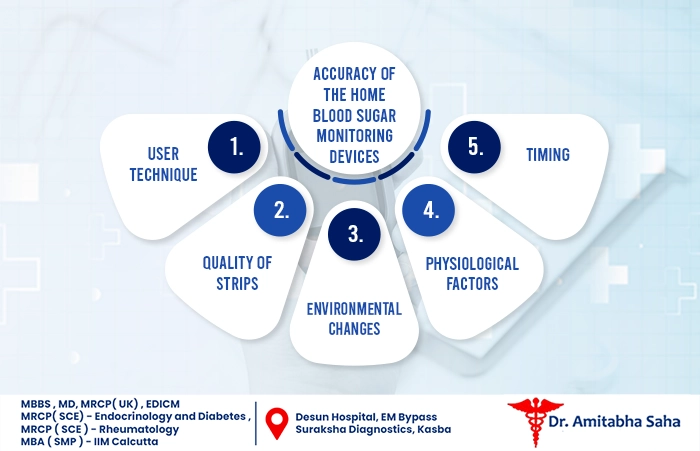
There are several factors that affect the accuracy.
User technique: How you use your device matters a lot. For example, an insufficient blood sample, low red blood cell count, or even contaminated hands can impact results.
Quality of strips: Test strips are extremely crucial for accurate results. Dirty, damaged, or outdated strips give faulty results.
Environmental changes: Most glucometers are designed to work within a specific range. Hence, extreme heat, cold, or moisture can affect accuracy.
Physiological factors: Certain body conditions affect the readings. For example, individuals with dehydration or poor blood circulation can have altered measurements. Moreover, high doses of vitamin D and other medicines even interfere with the results.
Timing: Blood sugar levels fluctuate throughout the day, whether before meals, after meals, after exercise, or during illness. Testing at the wrong time can result in perceived inaccuracies.
Image
Role In High Blood Sugar Treatment
According to Dr. Amitabha Saha, glucometers or home blood sugar testing devices can be used as a guide rather than an actual diagnostic tool.
Testing at regular intervals is necessary to validate results and adjust the treatment plans if necessary. Based on the results of the report, patients can detect the levels of blood sugar and prepare a personalised treatment plan to prevent complications.
In simpler terms, high blood sugar treatment in Kolkata, when combined with expert care from Dr. Amitabha Saha, is the backbone to keep the condition under control.
Conclusion
While home sugar monitoring devices might not be perfect, they are somewhat accurate enough for everyday use in diabetes management. However, always try to consult your healthcare professional for guidance and take control of your health.
- Dramitabhasaha
- 22nd May, 2026
- Diabetes Treatment
- Tags: High Blood Sugar Treatment in Kolkata